Monday, 10 March 2014

Getting ready for exhibiting at Flower Shows

Showtime

There is an awful lot of behind the scenes activity goes on pre-doing any of the flower show exhibits. Hilary who is in charge of show plants and their welfare is continually moving plants into or out of a tunnel depending on the vagaries of the British weather.....

For smaller exhibits we are moving in our 3litre plants to use in groups. these will be laid out in the show tunnel in batches weekly or fortnightly, batch sizes vary from 10-15. It is not quite an exact science but does follow some rules after many years of experience.


 However they do not stay in one place for very long depending on the growing year. Some batches remain outside, others are in either a tunnel or shade area. We have to keep an eye on their watering and feeding requirements to ensure good steady growth not excessive bursts. Within this we also move some plants in and out of various conditions to try to slow or progress the plants towards their peak.


Grow lights are required for some of the more reluctant to flower plants...

Hilary is not somebody who swears but as Chelsea flower show approaches each year and some plant is not performing as it should encouraging words change to #***##**. (make up your own thoughts)

Carefully tied up for transport in the lorry to the show, already cleaned.


When we get the plants to the shows even though they have been cleaned up prior to travelling it is inevitable that they still require further attention. This has to be done by those who have patience.

Large show plants are placed in position tipped up on blocks if necessary to show off their best side. If the plants are too heavy in a pot for me to be able to lift next year they are split and put into smaller extra large pots!
and finally they should look like this for Judging...


Once the labels have all been put into place we have to walk around the stand numerous times to multicheck there is nothing missing...
I do all the labels by hand as apparently my hand writing is the neatest!!
Once it is judged that is it and the display is there for people to admire.


Wednesday, 5 March 2014

5 top tips March

 
1.Plant snowdrops in the green. Lift large clumps as the blooms fade and split in to small clumps to replant.

2.Cut off old leaves from Epimediums to allow you to see the beauty of the new young leaves and flowers.
 
Epimedium grandiflorum "Lilafee"

3.Cut all dead untidy leaves off Heucheras to ground level. If plants are large enough lift and split now.
Heuchera "Obsidian"

4.Start sowing drills of vegetable seeds batch sow, or you will have too many ready all together.

5. The yellow book of National Garden Scheme open gardens is printed either as a local county version or the whole country so get a hold of a copy and go visiting.


Wednesday, 12 February 2014

Seeing Red?

What is red?

        All of these are described as red.
Colour and tone are something 
that are difficult to explain. 
Looking at a flower open in the 
morning it colour will change 
throughout the day depending 
upon the intensity or lack of 
sunlight thus changing the hue.
So what you perceive to be one 
colour may be completely 
different to another persons.

Remember just a scent and taste are personal so is colour, your colour perception and preferences should not be foisted onto others but take into consideration other points of view.


All the following are red of similar hue but vary in appearance due to many factors. The stamen colour where visible is red to orange to yellow, creating a different feel to the red colour. this difference means that it can be placed with many other plant colours. the black spots on the Papaver commutatum or Ladybird poppy draw the eye in.
 The more double the petal formation the more change in the colour due to the amount of surface area for reflection of light. So the soft frilly effect of ruffled petals in the Paeony (P.'Henry Bockstoce') soften the colour. The Monarda 'Jacob Cline' with its fine multi petals again give another feel to the colour.

So from bright reds to those with more of a burgundy tint, but again shape of petals, rainwater and different centres changes how they appear. From the tall elegant Angelica gigas to the black centred Potentilla 'Monarchs Velvet' these will draw the eye forward.

Then when you add in a bit of white or green to the mix they change again and the planting combinations that are possible are again different. How about those reds that border on the pink side as in Trifolium 'Red Feathers'.
I advocate playing an trying out colour combinations to enhance your borders as in the saying "anything goes"


Friday, 31 January 2014

Pulmonaria

Pulmonaria - Lungwort

Pulmonaria 'Opal'

Pulmonaria 'Diana clare'
Lungwort used as a remedy for lung infections
before modern medicine came along. They have
many common names which can be misleading.


Pulmonaria 'Rosy's Mum'
Pulmonaria 'Blue Ensign'
                                                           
Pulmonaria rubra 'Redstart'

Not all forms have the silver spotting on the leaves, however most are clump forming. One of the exceptions are the rubra group which are thugs and should come with a garden health warning. They are useful though for the areas in the garden where most other plants wont grow.

Plain green foliage enhances the colour of the flowers as in
"Blue Ensign"


Pulmonaria 'Trevi Fountain'


Most of the large silver spotted leaved varieties if given a haircut after they have finished flowering will produce good clean foliage that is resistant to slug damage.
This will mean that you can have good shade foliage ground cover without holes or the need for slug control.
Remember that these plants do require a good amount of moisture so planting in a dry sunny position is the quickest way to get a sick looking plant.


Division in august is the best solution and this will give you some good looking autumn foliage, as well as head start for the next season flowering. You will find they have an extensive root system which is why they don't like to be in too small a container for any length of time. It is possible to container grow them but do give them a large container with plenty of moisture and organic matter.


Friday, 17 January 2014

More spring beauties

Anemone nem. Pink Blush
Anemone nemorosa are a wonderful spring plants that carpet the floors of deciduous woodland especially hazel coppices pre the bluebells coming out.

Anemone nemorosa

Anemone nem. Alba Plena

Anemone nem. virescens

Anemone nem. 'Bowles Purple'

There is a wide variation in colour and size of flowers within the name varieties.
All are summer deciduous so as soon as they have set seed they disappear for another year
a fleeting but magnificent display. They are well worth growing under deciduous trees and shrubs as early flowering ground cover.

Anemone nem. 'Royal Blue'


Often you will spot them flowering and forget they had been planted and this is always a good surprise.


All Anemone nemorosa are best planted as growing plants, they will establish far better. The dry packaged rhizomes sold and planted in October tend to be rodent fodder!! Also should be rehydrated pre planting.
If you are planting these out in the autumn make sure that they are given a soak in water prior to planting. I advise that you plant with chicken wire around the rhizomes to protect from squirrels and mice.
Also place a label underground with these plants as the other main culprit of them disappearing is You digging them up. The rhizomes look like twigs and are often thrown away after a tidy up.


Anemone x lipseniensis


Anemone x lipseniensis is slightly more refined with
lovely purple foliage and soft lemon flowers as contrast.
Slower to colonise an area so patience is required.


Friday, 10 January 2014

Lanzarote December 2013

The off season playtime!

I have come out for a break by myself to dive, last time Rob came with me the the weather was not good for a land lubber. He does not like the sea or too much sun, but cold winds and clouds we might as well have been home, water is wet!!!
I on the other hand was having some fabulous dives. If anyone tells you there is nothing to see here they must be blind.
So I am out here to be able to dive dive dive ha ha the gods are not on my side.
I arrive and the first day we do 2 good dives but getting out on the second dive was a bit hairy, by the time I was on my bum for about the 5th occasion, I decided staying there taking the fins off with huge waves going over me was the safest option.
Then 3 days of no diving, so what to do? Well there are plenty of volcanoes to climb..some people think that it is quite a desolate landscape but I love the geology of the place above and below. Even a chance
                                      to have a look at the
                                      different natural vegetation
                                      growing in such harsh
                                      environment.
These two little beauties
are amazing to actually grow
and survive.
If you look and observe there
are actually quite a few different
plants growing naturally in the 
wild spaces.


So when we did get back in the water it was angel shark fest! these are the most incredibly beautiful shark you can want to see both resting or swimming effortlessly. It was just about full moon and the females were coming in but its 2mths early. Heavily pregnant or just sitting tails out to attract a mate...


 Pink coral not something there is
a lot of in the waters off Lanzrote
but where it does grow its beautiful.
This dive it was only feeding slightly with a few polyps open.
 Yellow frogfish on one of my last dives, the last time I had seen one of these strange looking fish was when diving in Jordan.

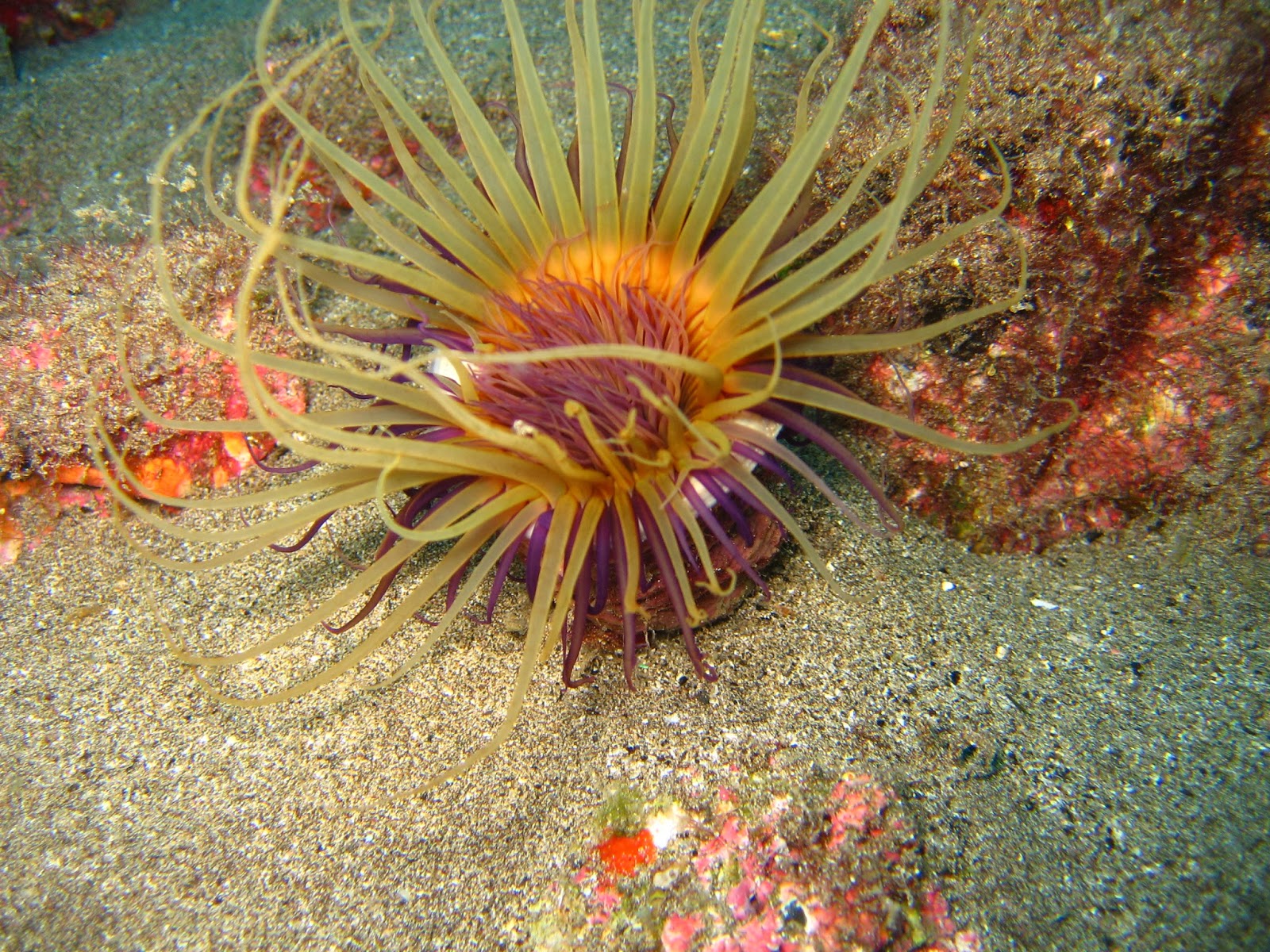
 This anemone has the most beautiful purple and orange colouring. There are so many types of these in the waters here.

Lastly you can also go below ground on the island and it does not have to be in the large tourist attractions. If you can find a guide to take you there are volcano tubes to explore which are fascinating.

Lapa was not too sure this was the best walk in the world but he endured it...
One of the best Diving Instructors is David Thompson who is allied to La Santa Diving. He can spot some excellent wildlife.

Tuesday, 7 January 2014

Hellebores

Helleborus x hybridus 'Red Lady'
Helleborus x hybridus
 Helleborus a very large  group of exciting perennials for growing in shade to full sun. They are the heralds of spring.
The x hybridus types are the most commonly grown being easy garden plants with
a lot of coloured selections being named. Quite a few of these are grown from seed and this does give quite a bit of variation within the groups.
Helleborus x hybridus 'Yellow Lady'
Helleborus x hybridus 'White Lady
Helleborus x hyb.double Queen mix
Many different forms have been bred by crossing different species and there are some amazing varieties out there for the keen collector.
Helleborus x ericsmithii 'Bob's Best'


Double forms are frequent even in seed raised varieties.


Helleborus foetidus

Helleborus argutifolius
Helleborus sternii

The specie types are also very useful in their own right as garden worthy plants as they are able to tolerate specific conditions.


Inter-specific crosses were hard to initially raise with this beautiful example being the first. They are now becoming more common and make incredibly floriferous plants that bulk up in the garden really well.


Helleborus 'Walbertons Rosemary'