Monday, 28 March 2016

Chelsea flower Show 2016 - Forever Freefolk cont'd 4

The trials of a Chelsea show garden continue....

Flints and bricks go so well together in
walls, sometimes even with stone.
There is something welcoming about a
flint and brick wall that is timeless.
Flints as a wall building material have
been used for centuries as they make
good filling material adding strength
to the wall when held in place
by brick or stone.
Flints used to be traded in the same way as gold and were worth far more.


How do we use the idea of brick
and flint walls in a modern way
to go with the conceptual idea.
Gabions are used for effect and as structural walls.

Sourcing the correct flint and gravel has given me sleepless nights. Not many people can say the flints are giving me nightmares.....


The wire casements give the rigidity and form, with the fill of brick and flint making the structure stable. The beauty of the different surfaces of the flint is visible through the wire, without the need for mortar.


The dried riverbed floor is a mixture of different sizes of flint gravel. Through this will be colourful plants which thrive in these stony conditions.


Erigeron Quakeress a wonderful summer flowering perennial to 45cm when in flower.


Centaurea simplicicaulis makes tight mounds of grey foliage with these lovely pink cornflowers.


Nigella or 'Love in the Mist' will self seed giving a carpet of blue. Then its seed-heads look good for the rest of the season.


Achillea 'Gloria Jean' a good strong pink form that thrives in gravel areas.

All of the above plants and their close relatives make excellent gravel bed plantings.


Facebook
Twitter


Wednesday, 24 February 2016

Chelsea 2016 - Forever Freefolk cont'd 3


Why have we used the pattern we have, for the feature sculpture within the garden?
Who could not marvel at the beauty and intricacy of the above structure.
What is it?
This is a Coccosphere, or in simple terms a group of phytoplanktonic creatures from the Jurassic period, individually known as Coccolithophores.
Chalk is an amazing sedimentary layer laid down when our seas where at 20 degrees centigrade.
I would have loved to have been around then to scuba dive in such amazing waters with so much incredible life.
Using this wonderful matrix we designed both our sculpture and the coccolith stepping stones.

A coccolith is the skeletal remains of the creature, which is what we see today under the microscope within chalk.

The vision was to make the sculpture looks as though it is floating above the source of the crystal clear waters of the chalk stream.
Models help with the ideas giving a 3 D aspect, to iron out any flaws. With the help of our in house architect we were able to make an initial model. From this not only do we see how the sculpture will sit within the garden but also where we need contouring.

Going on from that, is the realisation of how to forge this in Aluminium and also how to make the whole thing work.


Attention to the details is the way to make all of these plans come into realisation. By having  a great partnership with the team, who can think about how the dream can become reality.
Sketches always help to consolidate the ideas; but although they give a certain perspective you still need to have working models.


This is where modern computerisation comes into its fore.
The foresight is brought into reality, showing the floating Coccosphere with the elevated path going through.
The designers vision is visible giving everyone a great perspective of the idea.


The process from here on is to have the model in physical pieces at a 5th size to make sure the joints work and the look are exactly as required.
It is from this stage that foundry casts will be made. Once made there is the possibility of changing colour. This can be an endless task as it an be spray painted to give any effect required. Definite decisions have to be taken.
Who knows what the finished Sculpture colour and texture will be?
That is for you to wait and find out....


Facebook
Twitter

Saturday, 19 December 2015

Chelsea Flower Show 2016 - Forever Freefolk cont'd 2


Inspiration comes in many forms it can be a word, or in this case it can be a picture with elements that give the basis for the ideas to create a conceptual garden. This wonderful fishing hut with the eel traps floating above the crystal waters of the river test, gave rise to the floating pathway running through the garden. The idea of some structure as a feature hovering over this path way was the next element to be designed, for this we went to the microscopic plankton that make up chalk.


These organisms are called coccolithospores which group together forming a coccosphere which is what we based our feature on. Above is the initial ideas of how it would look hovering over the water source. But as with all ideas and the practicality of functional design it has changed slightly.      


This was our first working model.
After this and many more detailed alterations that make the design operational the below cartoon is the finished article. Ready to star being put together in May 2016 for everyone to see.


Tuesday, 8 December 2015

Chelsea Flower Show - Forever Freefolk continues 1

This is very much a note by note progress of the way we worked to achieve securing a show garden at Chelsea flower show.

A show garden on main avenue at Chelsea flower show, how long can this take to go from bidding for sponsorship to applying for the space?

In truth we had 48hours to put a proposal forward to the sponsors Brewin Dolphin, one of the most renowned Chelsea sponsors.
After this a short list, which we made and then the need to do a presentation to really make the bid stick. Preparation time for this another 36 hours, talk about a tight time-scale.

Where do you begin but with a starting sketch from numerous ideas. To be honest that was not the starting point. It started with a scrap of A4 with various single words to describe the wonderful area we live in here at Freefolk in Hampshire. We live in the most amazing landscape, that over the geological era has changed significantly, through the ages.

The underlying area is made of chalk a very interesting material that can act like a sponge.

Chalk was laid down over a prolonged heating of the oceans many millennia ago. The seas were at 20 degrees Celsius the plank-tonic life was rich, the dying bodies of these coccolithophores end up on the seabed. The skeletons made from calcium carbonate of these creatures are known as coccoliths and it is this that is the backbone of the chalk.

How to integrate this beautiful natural structure into the garden design, was the next step.

All the ideas of what to base our design on had been narrowed down to the Chalk streams, Chalkdownland, Local industry and the effects upon the area.
The industry heritage is one of security paper-making. Portals make banknote paper, with the watermarks and silver threads for increasing the security of banknotes. This was all due to the Huguenots who moved here in the 1730's.
The river and path running through the garden are the silver thread.


Many of our naturally occurring features of Hampshire are utilised within the concept of this display garden.

The main underlying concept of Chalk streams is key to the story.
'Chalkstreams are our Rainforests' and are a very much a fragile important ecosystem that need protecting for our future.
Too much water extraction and we could end up with dried up streams as in our concept garden. Depicted by gravel planting and coccolith gabion stepping stones.


There are many elements to all designs, with various ideas coming and going.
Many times the constraints are monetary, as in many things in life meaning other paths have to be taken to reach the same goal.


Friday, 4 December 2015

Bright and beautiful cut flower plant collection

This collection of plants I have chosen for ease of growing and flower colour. They are certainly not subtle but bright and beautiful enough to lift your mood on seeing the gaiety.

Geum "Totally Tangerine"
This is the best new breeding in Geum for a long while,with its large single flowers in a soft tangerine. This colour is able to be used with various other combinations. It is ideal for cutting as it has long stems and numerous buds per stem that open over a long period. Grows in most soils and prefers a sunny site.
It flowers continuously throughout the season making it a really great garden and cut flower variety.


Achillea "Pomegranette" Tutti Frutii series
The Tutti Frutti™ Series of Yarrows were bred in the Netherlands. They are more compact and bushy, than other forms. They have rich pomegranate red flowers of very uniform size, with large individual florets that hold their colour. Excellent for cutting, deadheading any old flowers throughout the season will encourage more new buds.  They are suitable for the mixed herbaceous borders or amongst grasses, they also are suitable for growing in containers.


Aster Little Carlow
This wonderful aster is a cross  between A.cordifolius and A.novi-belgii producing masses of lilac/purple flowers in Autumn. Just an aside which I am not going to delve into but these are going to be known by the name Symphyotrichum Little Carlow.
Do not be misled by the name Little Carlow it has nothing to do with its height it is named after a hill.


Lychnis Gardeners World
Most gardeners will be very aware of the normal Lychnis coronaria with the single flowers which can become a nuisance due to its habit of seeding freely. This double form will not seed but does produce a profusion of flowers throughout the summer season. A sunny dry site is ideal for this plant giving a great contrast with its silver foliage.


Salvia Madeline
This unusual two tone salvia was a chance seedling chosen by Peit Oudulf in the Netherlands.
It is happy in a sunny site grown either in a grass border or with mixed planting. By picking regularly or deadheading it blooms well through the summer.

Tuesday, 10 November 2015

Forever Freefolk - Chelsea Garden 2016

                          Forever Freefolk


Chelsea flower show 2016 will be a challenge for me next year as I embark on a new venture, to take on the challenge of a Show garden for the first time...
This will be the 25th year I have exhibited at Chelsea and not only am I doing a Chelsea show garden for the first time but at the same time I will continue to be building the dynamic plant display within the Floral pavilion. As far as I am aware this will be the first time anyone has taken on this monumental task!!!

Just to give a taster as to the requirements of a Chelsea garden.

1. You need an outstanding sponsor - Brewin Dolphin
2. A brilliant contractor - Bowles & Wyer
3. Fantastic plants - Hardys Cottage Garden plants
4. The most amazing back up team
5. As per NannyMacphee2 - Lesson 5

So this is just the initial notice, more information will be given out .....so follow this blog for more enticing snippets of how to succeed with a garden at
The Chelsea Flower Show......

A spark of an idea "chalk streams are our rainforests"

Monday, 27 April 2015

What's new for Chelsea 2015 - Second plant

Antirrhinum "Pretty in Pink"
Usually thought of as a traditional cottage garden plant or for use in big colourful bedding displays usually as an annual or biennial.

This new introduction is a perennial form with wonderfully glossy dark green leaves and strong pink flowers throughout the summer into autumn. The breeder Peter Moore has been working with these plants for a while to encourage the  free flowering habit by using Antirrhinum majus subsp. Tortuosum as the main breeding crossing it with other hybrids. Rust resistance is also an important factor to highlight along with hardiness similar to penstemons. The individual florets are slightly smaller than their cousins, they are very free flowering giving a wonderful show. Ideal for any flower borders or container grown, pruning back will encourage bushiness and encourage more flowers.

Tuesday, 21 April 2015

Whats new for Chelsea 2015 - First plant!

Its that time of year again when thoughts are heading towards the greatest flower show. Chelsea 2015 is fast approaching so what wonderful new introductions are we bringing to the party?
For the last 3 years we have made it our policy to only launch UK bred plant material and this still holds. It has to be said we have been offered some very interesting new plants from worldwide sources but have had to say no.
So what have we got to offer you?
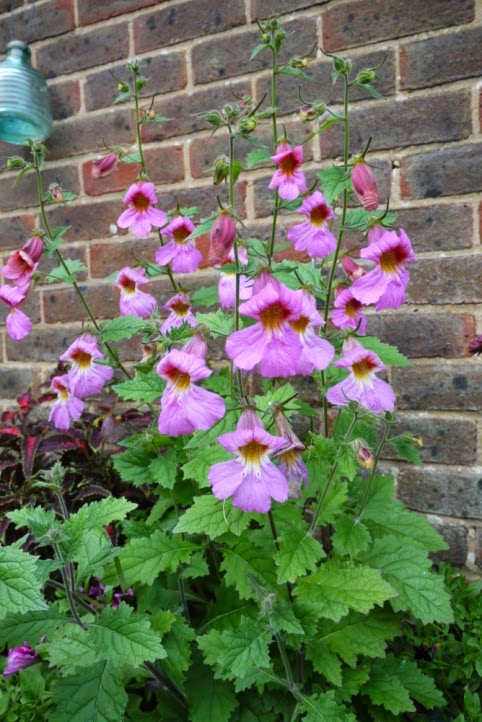
Here we go I will start with Rhemannia Walbertons "Magic Dragon"


A world first Rhemannia elata x Rhemannia glutinosa

Rhemannia elata in this case the epithet elata means tall. They have hairy stems and leaves with tall spikes of large pink flowers with a yellow throat. This variety is easily grown from seed and can be variable. The common name of Chinese Foxglove is as usual with common names misleading as they are not related to Digitalis, it is due to their appearance and the fact that the plants originate from China.

Rhemannia glutinosa a much shorter growing variety with very hairy stems and leaves which is has a higher hardiness rating. The flower colour is more a dusky orange/red.


The wonderful thing about having parents with these characteristics is that the subsequent offspring have been chosen for a combination of parental characteristics. 
Rhemannia " Walbertons Dragon" is very free flowering producing numerous stems per plant over a very long flowering period from May until the first frosts. With a neat tidy habit and very large dark pink flowers a favourite of the bees, giving great garden performance. 
This will be a great addition to any garden for sun or part shade in any reasonable soil. For those who love to grow something different in containers this will also be ideal giving so much pleasure throughout the summer. Occasional dead-heading will be necessary and liquid feeding recommended for growing in a container.


Friday, 2 January 2015

Behind the scenes Natural History Museum contd...


contd
After the wonders of the frozen specimens we moved to the area of a much older technique of storing plant material which is still used today, pressed plant material. The herbarium specimens ranged in age but were all impressive, especially with all the historical persons with whom each had connections.

Before we get there however we need to use the lift.....
Not once but twice someone being a gentlemen allows the others to get in the lift, only for when he gets in for the lift to say overloaded....


It will not stop him eating cake at the shows tho

Here we go the herbarium 


I'm not even going to list all the names on display, just lets be honest and say we were all in awe...


Just when you think you have seen some memorable items it seems to get better.
How about samples from the first voyage of the Beagle, collected by Banks and Solander.


This is the first collected sample and also identified Banksia....such an iconic plant.

Other samples do not have such a good story for this one apparently is now extinct


Other material we saw had its significance, newer subjects pressed and labelled in the same way as older subjects.
We still use this form of herbarium  specimens today. 
Modern technology is however starting to help with the digitising of all specimens in the herbarium it will take years. The photos of the plates is the easy bit. The deciphering of the field notes is the bit that takes a while longer, a lot of collectors were doctors!! Also not all field notes are on the front some additional information is on the reverse.


Some of the modern samples have helpful map locations.

The tour probably created more intrigue and a list of questions from all who joined us.
I for one so want to visit again.
The day would not have been the same without meeting up for a long lunch.


A fabulous day of which I have only skimmed the surface.
Great company. 
Here's to many more outings.


Tuesday, 23 December 2014

Propagation

What, when, how and why to propagate plants for your garden.
These are the questions a lot of people ask and is the purpose of the fun filled hands on propagation workshops I will be hosting here at Hardys.


Are you frightened to cut up your plants?

Do you know where to cut them off?
What is the difference between nodal, internodal, tip, root, basal cuttings?


If you want to learn more and get your hands dirty this is the course for you so go to Propagation workshop - Spring

Thursday, 18 December 2014

Behind the scenes at the Natural History Museum

 We were very lucky to meet in the summer at Waterperry gardens a lovely lady Jackie McKenzie-Dodd who works at the National History Museum she mentioned that a trip around may be possible. So a plan was put forward for a group from OldHorts who would meet up and have a behind the scenes tour. The resulting day has non stop been talk and discussed continually since.
Normally you expect to go in through the grand front entrance not us it was the side doors. So what do we think the collective noun for OldHorts should be?
Once inside poor Jackie and Justin had the unenviable task of getting us all sorted into 2 groups with all passes in place. Then making sure we did not get left behind down all the different corridors, too much to look at.


Perhaps we all felt at home?
It's quite different being taken to the working areas hidden behind those little doors that say staff only.
You move from the rich tapestry of wooden panel rooms amazing brickwork and tiled floors to the stark reality ......


Oh well what do expect there is always an upstairs /downstairs in these places nothing new....
So once we were in this area it was time to see what Jackie gets up to, and where all those dead specimens are stored for use at a later date for research. ( no Paddington is not in here)
It was time for us to get all dressed up, some make this look good others well I leave it to you to describe it....


Now we were ready to clean the floors, it was time to look at the amazing range of storage for all the samples. The lines of freezers are all named not with what you may think is inside. The names are for ease of knowing which to go to should there be a problem and also for extracting samples to send off all over the country and globe. Everything is wired to the main control board and the temperatures monitored. They can send an alarm to a mobile should there be a powercut or a breakdown. Being called at 2am by a polar bear is so much better than freezer number 00251, most of us would be motivated to answer.


The freezers have numerous drawers should there be a major catastrophe the red drawer in each are the ones to be saved first. 
Obviously gloves are required to handle the trays as you can see the temperature is low. The room temperature is also low so there is not too much temperature raising when the doors are opened.
Within the trays the samples are held inside small phials, as not a huge amount of material is required to be kept. The samples sent out are small shavings, the scientist are looking at the cellular level, so sending too much material is a waste. It does mean that this is a huge resource for the world.


But obviously collecting out in the field travelling with a large freezer is impossible so mobile options range from hi tech to simple...


The cards will only store DNA but sometimes that's all that's required.
Dry samples are the easiest to transport.
So much information to take in and we had not been to see the mega storage that is the liquid nitrogen  vats.


Behind lock doors.....


Ooh this was like being in one of those science fiction movies.....oh or just an over vivid imagination taking over...
Some amazing sample material kept in here.
Jackie gives us the full demonstration, we get to see the samples in racks that were brought back from Vietnam. Although above these were some elephant blood samples taken by someone called Sir David Attenborough?!?


Oh no it's time to go on the other half of our tour.
We want to stay, there's a robot to look at...


Thank you Jackie and Justin 😊🐝🐞🐜